

Flooring as Architecture: Using Surfaces to Define Space without Walls
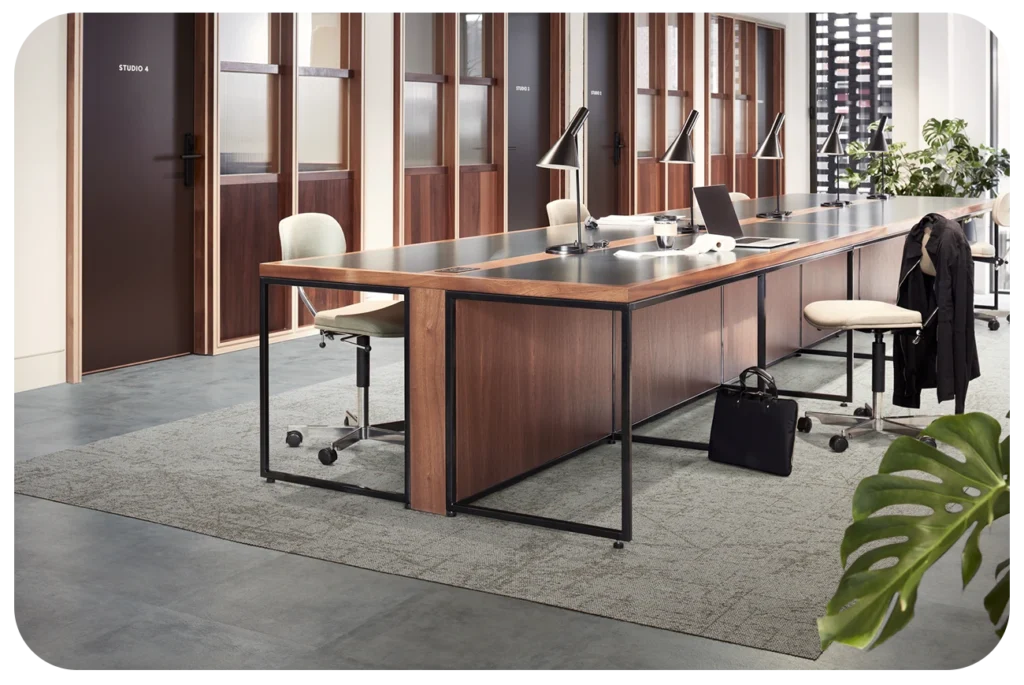
In activity-based work environments, the floor is your most powerful zoning tool, yet it’s almost always the last design decision made.
There’s a familiar sequence in commercial office design. Space planning happens first. Workstations, meeting rooms, and collaboration zones are mapped out. Partition systems are specified. Then, somewhere toward the end of the process, someone asks about the floor.
That sequencing is a missed opportunity. And increasingly, it’s one that architects working on modern workplace projects can’t afford to repeat.
As organizations move away from fixed-desk models toward activity-based working (ABW), the floor plane has quietly become one of the most powerful spatial communication tools available. Used intentionally, it can signal to occupants where to focus, collaborate, decompress, and move through, without a single additional partition, sign, or screen.
The End of the Homogeneous Floor Plate
For decades, the default commercial office specification was simple: one flooring material, wall-to-wall, across the entire floor plate. Usually, a mid-range broadloom carpet or a uniform hard tile. Practical, cost-efficient, and almost entirely neutral from a design standpoint.
That neutrality was, in many cases, the point. When offices were organized around fixed desks and closed rooms, the floor didn’t need to do anything except support foot traffic and look inoffensive.
ABW design changed the brief entirely.
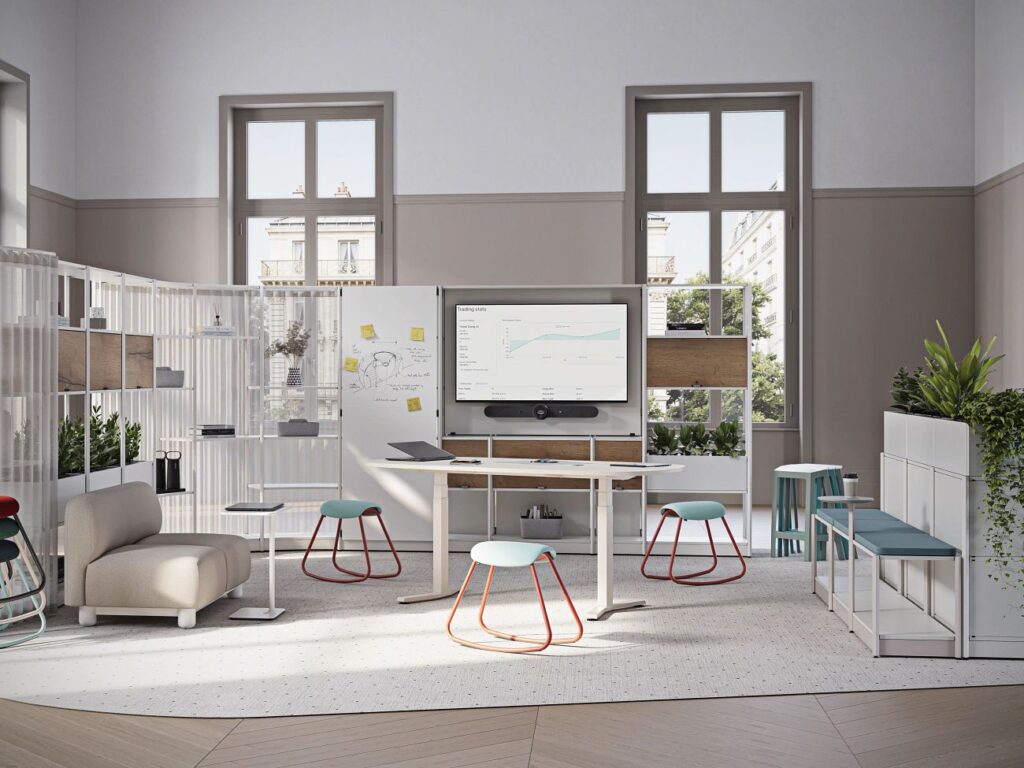
In an activity-based environment, there are no assigned seats. Employees move through different zones depending on what they need to accomplish: a focus booth for deep work, a standing collaboration table for a quick team sync, a lounge area for informal conversation, and an open project space for cross-functional work. The spatial logic of the office is now behavioral rather than hierarchical.
And behavior, it turns out, needs cues.
Research in environmental psychology consistently shows that people calibrate their behavior to spatial context. A softly lit lounge with upholstered seating and warm-toned carpet signals “slow down, informal conversation is welcome here.” A bright, hard-surfaced zone near a standing-height table signals “quick exchange, keep it moving.” These aren’t arbitrary associations; they’re learned responses to material and sensory environments.
The floor is the largest continuous surface in any interior. If you’re not using it to carry spatial meaning, you’re leaving one of your strongest design levers unused.
Visual Zoning: How the Eye Reads the Floor First
Before an occupant reads a wall treatment or ceiling detail, they read the floor. It’s the surface they’re most continuously aware of, not consciously, but peripherally, as a constant frame of reference for where they are and where the space is going.
This has practical implications for zoning strategy.
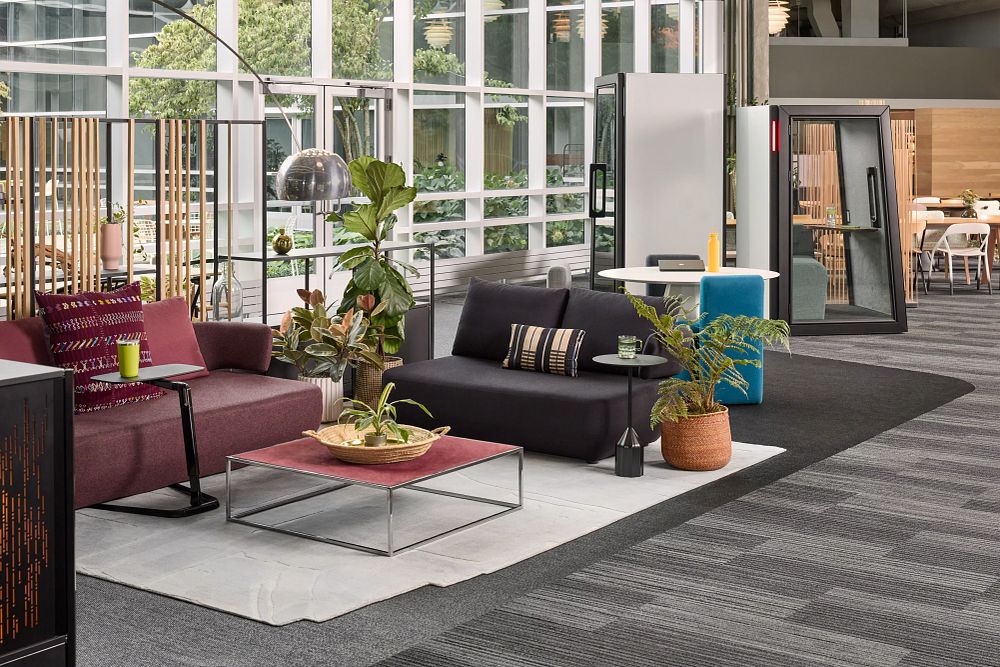
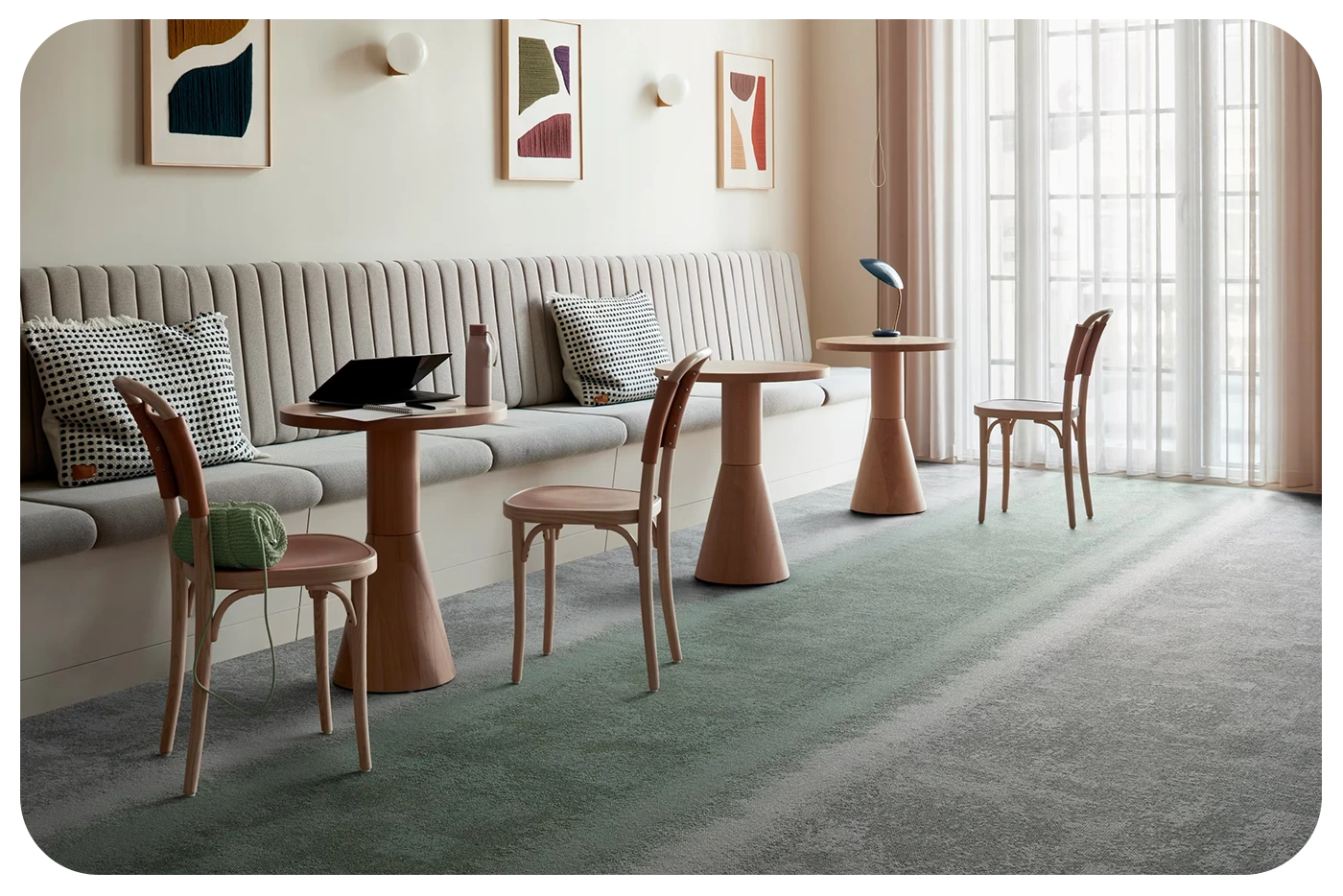
A transition from a structured, geometric carpet tile pattern in a focus zone to a warmer, more organic texture in a breakout area communicates a shift in spatial character at the most fundamental perceptual level. It doesn’t require a threshold, a door, or a sign. The floor does the work.
The most effective visual zoning strategies use three levers:
Color contrast. A shift in palette, even a subtle one, marks a zone boundary. High-contrast transitions between work zones and circulation paths improve wayfinding without any additional signage. Softer contrast between adjacent work zones creates a sense of flow without hard visual interruption.
Texture and pattern scale. Dense, structured patterns tend to read as “active” or “task-oriented.” Looser, more organic textures read as “relaxed” or “social.” Mixing pattern scales across zones reinforces the behavioral intent of each area.
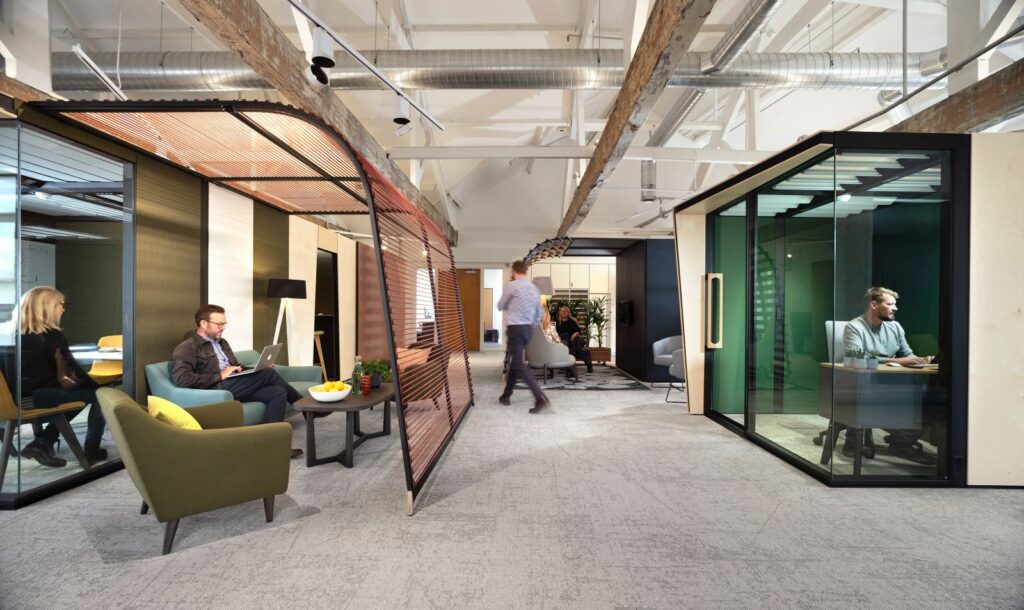
Material type. The shift from carpet tile to a resilient hard surface (LVT or similar) is one of the strongest spatial cues available. Hard surfaces carry sound differently, feel different underfoot, and create a distinct visual register. Used at a transition point, from a collaboration hub into a reception corridor, for instance, that shift is immediately legible to anyone entering the space.
None of this is new to experienced designers. What’s changed is the availability of modular flooring systems that make these transitions technically seamless, at a scale and flexibility that wasn’t possible with broadloom or large-format hard tiles.
Hard-to-Soft Transitions: Getting the Technical Details Right
The design intent is one thing. The specification detail is another.
For years, mixing carpet and hard flooring in a single open-plan space meant managing height differentials, transition strips, and the aesthetic disruption of a visible seam. In a modern ABW floor plate, where the zoning strategy might involve four or five distinct flooring areas, that meant four or five visible interruptions to an otherwise continuous floor plane.
Contemporary modular flooring systems have largely solved this problem. Height-compatible carpet tile and LVT systems, designed to sit at the same installed height, allow direct transitions without transition strips, without trip hazards, and without the visual clutter of a visible threshold.
A few technical points worth verifying at the specification stage:
Installed height compatibility. Not all carpet tile and LVT systems are designed to be height-compatible. Confirm total installed thickness (including any acoustic backing) against the LVT system before specifying a seamless transition.
Subfloor requirements. LVT is more demanding on subfloor flatness than carpet tile. If you’re specifying both in the same space, the subfloor standard needs to meet the LVT requirement across the entire area.
Edge treatment at zone boundaries. Even in height-compatible systems, an exposed edge between tile types benefits from a considered detail. A simple color-coordinated or contrasting border tile can turn a technical necessity into a deliberate design moment.
Adhesive and installation method. Mixed installations may involve different adhesive systems. Coordinate with the installation team early, particularly if phased installation or future reconfiguration is part of the brief.
Four Zone Typologies and What They Need from the Floor
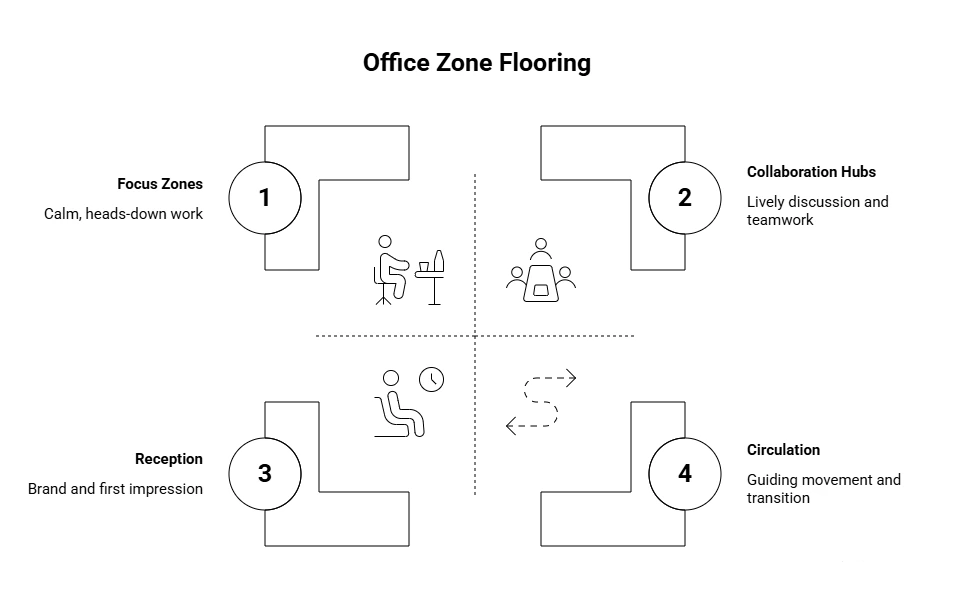
Here’s how flooring strategy maps to the four core zone types in a typical ABW office.
- Reception and Arrival
The arrival experience sets the tone for the entire space. This is where brand, quality, and design intent are communicated in the first five seconds.
Hard resilient flooring, LVT in a stone or refined timber analog, works well in reception zones. It reads as polished, durable, and easy to maintain. It also handles the acoustic reality of hard-soled footwear on a high-traffic surface, provided an acoustic-rated backing is specified.
A transition to carpet tile as the occupant moves deeper into the space creates an immediate, felt shift from “public threshold” to “workplace interior.”
- Focus Zones
Focus work requires acoustic support and a sense of enclosure, even in open-plan environments.
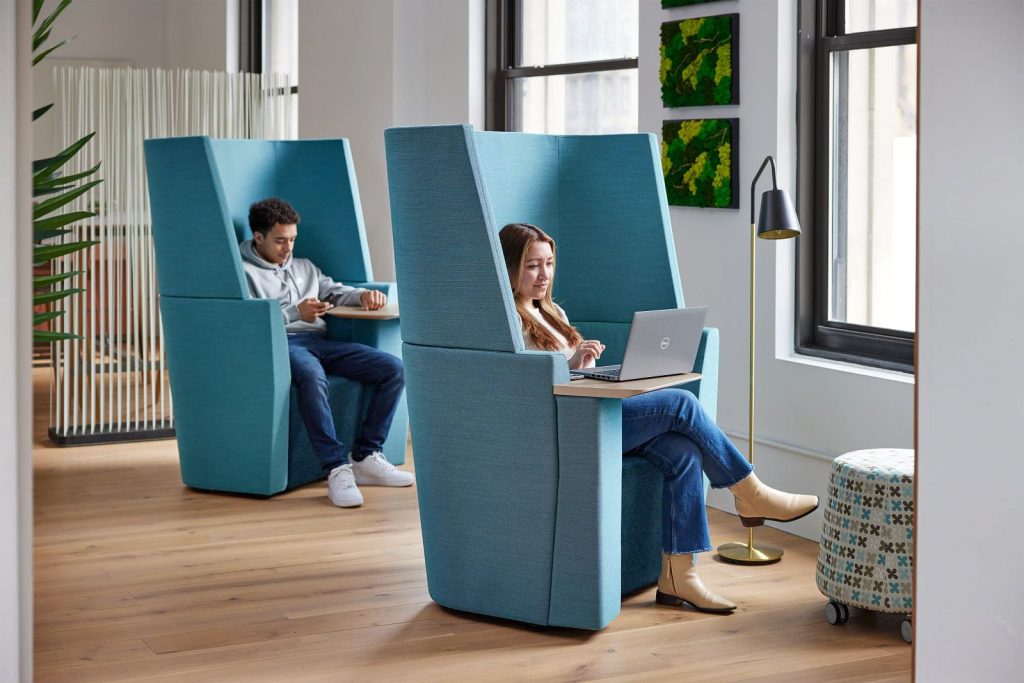
Carpet tile is the natural specification here. Its sound-absorbing properties reduce ambient noise at floor level, and its softer material register contributes to the “calm, heads-down” character the zone needs to communicate. Pattern and color should be understated; the zone is about reducing distraction, not creating visual interest.
- Collaboration Hubs
Collaboration zones can accommodate harder surfaces more comfortably than focus zones, particularly where standing-height furniture or high tables are in use.
A durable, easy-to-clean LVT or a robust carpet tile with a tight, low-pile construction works well here. If the zone is semi-enclosed or acoustically treated at ceiling level, the harder floor surface is less of a concern. If it’s fully open-plan, consider a carpet tile with a denser construction than the focus zone, enough acoustic performance to contain some of the noise generated, without the full soft-surface treatment.
- Circulation and Transition
Circulation paths are often over-specified in carpet (adding unnecessary wear-zone complexity) or under-specified in LVT (creating noise funnels that carry sound across the floor plate).
The most effective approach is to treat circulation as a distinct zone with its own specification logic: a hard or hybrid surface that’s acoustically rated, visually directional (guiding movement without explicit wayfinding signage), and designed to withstand the highest foot-traffic intensity on the floor.
A simple tonal shift — slightly lighter or darker than the surrounding zones — is enough to mark a circulation path without interrupting the overall design narrative.
The Flexibility Argument: Specifying for the Office That Doesn’t Exist Yet
One of the strongest arguments for modular flooring in an Account-based Work brief, and one that architects are increasingly making on behalf of their clients, is future flexibility.
Consider a hypothetical scenario: a mid-sized professional services firm relocating its Athens headquarters to a new floor plate. The brief is ABW, the headcount is projected to grow by 30% over three years, and the organization is still figuring out exactly how its teams will use the space.
A monolithic flooring specification, one material, installed wall to wall, means any future reconfiguration of zones requires either living with a mismatch between the spatial strategy and the floor, or a disruptive and costly partial replacement.
A modular system changes the calculation entirely. Individual tiles can be replaced without removing the surrounding floor. Zone boundaries can shift as the organization’s needs evolve. A focus zone that becomes a collaboration hub in year two requires a tile swap, not a renovation.
For the client, this is a total cost of ownership argument. For the architect, it’s a credibility argument, it demonstrates that the specification was made with the building’s full lifecycle in mind, not just the handover date.
The floor plan and the flooring plan are not separate documents. In a well-designed ABW environment, they should be developed in parallel, with each flooring zone decision reinforcing the spatial and behavioral intent of the layout it supports.
The materials exist to make this straightforward. The modular systems are technically mature. The remaining gap, in most projects, is simply the habit of treating flooring as a finishing decision rather than a design decision.
If your next workplace project has an ABW brief, it’s worth asking the flooring question early.